
Sensor Active
MODULE TECH-DOC
PHOTOCATHODE GaAs III+
NOISE FIGURE ≤1.4 dB
Image Intensification · Thermal Fusion · Signal Processing

Night Vision
Technology

How darkness becomes data

Modern night vision systems operate on two core principles: image intensification — amplifying residual photons through a microchannel plate — and thermal imaging, which detects infrared radiation emitted by objects regardless of ambient light. Generation III+ devices combine a gallium arsenide photocathode with an ion-barrier film, achieving photosensitivity exceeding 1800 µA/lm and signal-to-noise ratios above 25. The result: reliable target acquisition at ranges up to 1500 m under starlight alone.

Gen III+ Intensifier GaAs Photocathode Thermal Core Microchannel Plate IR Illuminator Fusion Optics
Fusion Engine Active
MODULE FUSION-TECH
AI OVERLAY ENABLED
STATUS PATENT PENDING
Engineering Breakthrough · Dual Technology · Single Unit

Thermal Fusion
Night Vision

Thermal imager + NVD Gen III+ in one device — developed by our engineers

New · In-house Engineering Innovation

This is the first device to combine a Generation III+ night vision channel based on a GaAs photocathode with a full-spectrum thermal imaging module (8–14 µm LWIR) — inside a single housing and a single optical path. Both channels are processed simultaneously, producing a fused image in real time.

The defining feature: an on-board AI engine automatically detects warm targets and draws a precise perimeter outline around them directly in the operator's field of view. The operator sees the familiar green night-vision picture — and simultaneously receives a sharp orange contour around any person, vehicle, or animal detected by heat.

  • AI Thermal Outlining
    The algorithm detects a thermal signature and draws an outline around the object's full perimeter — no manual configuration required.
  • Dual-Channel Fusion
    The night channel (GaAs III+) and thermal channel (LWIR) are merged into one picture with analog blending control available to the operator.
  • Stealth — Zero IR Illumination
    The thermal mode operates passively: it emits no signal whatsoever and remains completely invisible in the dark to any opposing NVD.

Thermal Fusion Night Vision Device
Fusion NVD · Compact Form Factor · IR-Passive Operation
Generation III+ — Why It Matters
GaAs Photocathode · MCP Amplification · Auto-Gating

The pinnacle of
photon amplification

Generation III+ marks the highest tier of image intensifier tube technology commercially available. Unlike Gen I (single electrostatic tube, no MCP) or Gen II (multi-alkali photocathode, limited quantum efficiency), Gen III+ uses a gallium arsenide (GaAs) semiconductor photocathode — a material with quantum efficiency exceeding 30% across the near-infrared spectrum, versus 5–10% for Gen II.


The tube is coupled with an ion-barrier microchannel plate (MCP) that multiplies the electron cascade at gains of up to 50,000–80,000×. The "+" designation means the addition of an auto-gating circuit: the photocathode voltage is modulated thousands of times per second, preventing the tube from blooming when the operator transitions from total darkness into a lit environment — a critical feature in dynamic combat scenarios.

>30%
Photocathode quantum efficiency (QE)
vs. 5–10% for Gen II
80 000×
Max MCP electron gain
microchannel plate amplification
64–72
lp/mm
Resolution (FOM class)
vs. 25–45 lp/mm Gen II
<0.1
fc
Min usable illuminance
starlight + overcast operation
2000+
h
Tube service life (MTTF)
vs. 1000–1500 h Gen II
Auto-
Gate
Dynamic gating circuit
prevents blooming & tube damage
Generation Comparison
Parameter Gen I Gen II Gen II+ Gen III+ ★
Photocathode S-1 (AgOCs)
multi-alkali
S-25 multi-alkali S-25 / S-20 GaAs semiconductor
MCP None Standard Improved Ion-barrier film
Quantum efficiency ~1–3% ~5–10% ~10–15% >30%
Resolution (lp/mm) 18–25 28–42 40–52 64–72
Signal-to-noise (SNR) 8–12 18–22 22–26 28–32+
Auto-gating None None Optional Standard
Tube life (MTTF) 500–800 h 1000–1500 h 1500–1800 h 2000–2500 h
Min illuminance ~1 fc (moon) ~0.3 fc ~0.15 fc <0.1 fc (starlight)
US/NATO export class Unrestricted ITAR-controlled ITAR-controlled ITAR/EAR top tier
01
GaAs Photocathode
Gallium arsenide is a III-V compound semiconductor with a direct bandgap that perfectly matches the 600–900 nm near-IR spectrum. Its quantum efficiency exceeds 30% — three to six times higher than the multi-alkali photocathodes used in Gen II. More photons converted means a dramatically brighter, cleaner image under starlight and overcast skies with no IR illuminator.
02
Ion-Barrier MCP Film
The microchannel plate is coated with a thin ion-barrier film that blocks positive ions from bombarding the photocathode — the primary degradation mechanism in Gen II tubes. This extends tube service life to 2000–2500 hours MTTF and maintains stable SNR above 28 across the entire service interval. The ion barrier is the defining structural difference between Gen III and Gen II+.
03
Auto-Gating Circuit
The "+" in Gen III+ refers to the auto-gating circuit: photocathode high-voltage is switched on and off thousands of times per second, dynamically adapting to scene brightness. Transitioning from a dark trench into vehicle headlights no longer blinds the operator or damages the tube. Auto-gating is a mandatory NATO STANAG requirement for category-1 night vision devices.
04
FOM 2376+ Class
Figure of Merit (FOM) = SNR × Resolution. Our tubes achieve FOM 2376 and above, placing them in the US Army's Pinnacle and P45 export-restricted categories. At this FOM level, a person-sized target is identifiable at over 400 m in starlight without any active illumination — a capability unavailable below Gen III.
05
Near-Zero Noise Floor
The combination of GaAs QE and ion-barrier MCP yields an equivalent background illuminance (EBI) below 4.0 × 10⁻⁵ fc — meaning the tube introduces almost zero spurious noise into the image at any gain level. Operators describe the image as "cinema-clean" compared with the grainy output of Gen II devices at the same ambient light.
06
Why Not Digital / CMOS?
Modern CMOS digital night-vision sensors (Gen "Digital" / "Filmless") approach Gen II image quality but cannot match Gen III+ in SNR, latency, or photon sensitivity. Crucially, CMOS sensors introduce digital lag of 8–30 ms — a firing-accuracy liability. Gen III+ image intensifiers have zero digital latency: the amplified photon stream reaches the eyepiece in the same physics-limited time as unassisted vision.
How Fusion Works
01
Photon Intensification
The GaAs Gen III+ photocathode captures photons from starlight, moonlight, or ambient urban glow. The MCP amplifies the electron cascade at gains of up to 80,000×, producing the classic high-resolution green NV image. Auto-gating keeps the image clear through bright flashes and illuminated zones.
02
Thermal Fusion Overlay
An integrated LWIR microbolometer (8–14 µm) reads thermal radiation independently of any light source. Both signals are merged in a single optical path — the operator sees the Gen III+ night image and the thermal map simultaneously, with no mode switching needed.
03
AI Perimeter Detection
An embedded DSP module analyses the thermal channel in real time, identifies a warm object, and draws an orange outline around its full perimeter directly in the eyepiece. Targets are immediately visible — even through dense foliage, fog, or camouflage. Acquisition time: 0.4 s.
Waterproofing · NATO Compliance · MIL-STD Certification
Extreme Environmental Durability

Waterproof to 20 metres.
Battle-proven in any conditions.

Our night vision devices are engineered to IP68 / IPX8 (IEC 60529) — the highest civilian waterproofing classification. This means complete protection against continuous immersion in water at depths of up to 20 metres for 2 hours, tested at static pressure of 3 bar. Not splash-proof, not rain-proof: fully submersible without a single drop of ingress.

Every housing undergoes individual pressure-differential leak testing (PDLT) on the production line before shipment. The sealing system uses double O-ring channels with hydrophobic grease impregnation, aerospace-grade titanium fasteners, and an internal silica-gel desiccant cartridge that absorbs any residual humidity inside the sealed chamber — preventing internal fogging at temperature extremes from −40 °C to +65 °C.

IP68
IEC 60529 · IPX8 Certified
Continuous submersion · 20 m depth · 2 h duration · 3 bar static pressure · zero ingress
Double O-ring seals on all apertures — objective, ocular, controls, and battery compartment
Pressure-differential leak test (PDLT) performed on every unit before shipment — no batch sampling, 100% production coverage
Internal desiccant cartridge — factory-sealed, prevents internal fogging from −40 °C to +65 °C
Hydrostatic pressure valve equalizes internal–external pressure after rapid depth changes — prevents seal failure during fast ascent or altitude variation
MIL-STD-810H Method 512.6 (Immersion) — 72-hour salt-water immersion protocol at simulated sea depth, zero corrosion on all optical surfaces
MIL-STD-810H Method 506.6 (Rain) — 40 mm/h horizontal rain at 18 m/s wind for 30 min, full operational function retained
MIL-STD-810H
US Department of Defense Environmental Standard
Covers 29 test methods including temperature shock (Method 503), vibration (Method 514), drop shock (Method 516 — 1.2 m onto concrete), immersion (Method 512), humidity (Method 507), and blowing sand/dust (Method 510). Our devices pass all applicable categories.
STANAG 4447
NATO Image Intensifier Tube Performance Standard
Defines minimum SNR, resolution, and EBI requirements for NATO-interoperable night vision devices. Our Gen III+ tubes exceed the highest STANAG 4447 category thresholds — qualifying the device for use by NATO member armed forces without additional certification.
STANAG 4516
NATO Night Vision Goggle Interface Standard
Specifies the mechanical and optical interface for goggle-mounted NVDs on NATO-standard helmets (PASGT, ACH, FAST). Our housing is fully STANAG 4516 compliant — compatible with standard J-Arm, Norotos, and Wilcox mounting systems used across 30+ NATO countries.
MIL-SPEC MIL-PRF-16191
Image Intensifier Tube Performance Specification
The primary US military procurement standard for image intensifier tubes, governing FOM, halo, EBI, and distortion. Tubes used in our devices are sourced and tested to MIL-PRF-16191 Grade A — the same specification used in AN/PVS-14 procurement contracts.
IEC 60529 · IP68
International Electrotechnical Commission Ingress Protection
IP68 is the highest IEC rating for solid particle and liquid ingress protection. "6" = dust-tight (no particle ingress in 8-hour vacuum test). "8" = submersible beyond 1 m as agreed with manufacturer — our rating: 20 m / 2 h. Verified by independent accredited testing laboratory.
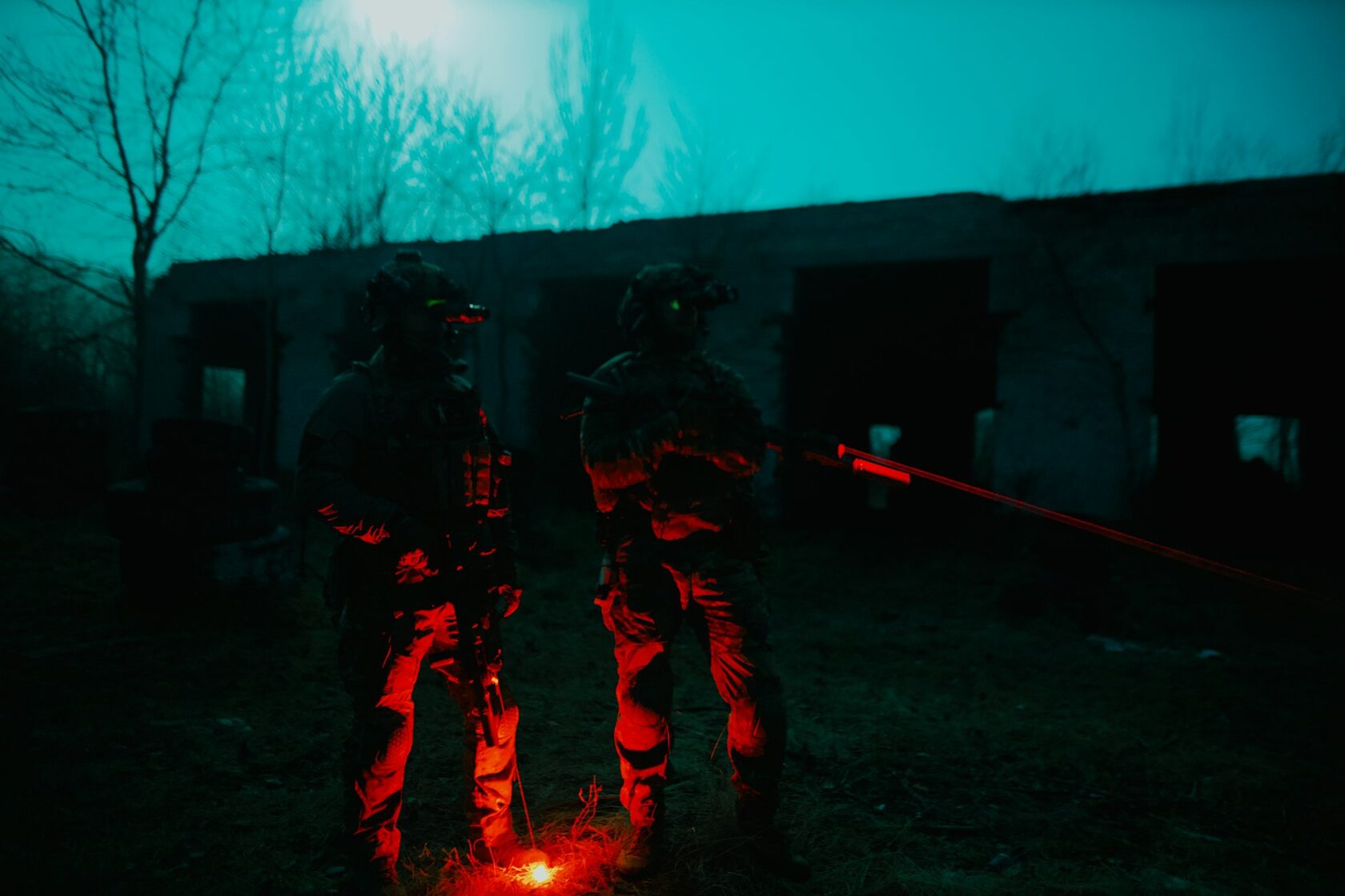
Stealth operation — no IR emission, invisible at night
IR-Passive · Zero Emission
Invisible in Darkness

The device is undetectable
even by enemy NVDs

Standard night-vision devices with IR illuminators emit a near-infrared beam that is clearly visible to any opposing NVD — like a spotlight in total darkness. The Fusion device operates entirely passively: the thermal channel uses no active illuminator and generates zero radiation of its own.

The platform is built on the same optical and electronic foundation as a conventional NVD — with an integrated LWIR microbolometer and fusion processor added. Minimal changes to the form factor; maximum tactical advantage.

Passive mode — zero self-generated IR emission at all times
Same housing — compatible with standard Gen III / NATO STANAG 4516 mounting systems
Three modes — NV-only, Thermal-only, or full Fusion — operator selectable
AI always on — active across all three operating modes
Target acquisition time — reduced to 0.4 s thanks to automatic outlining